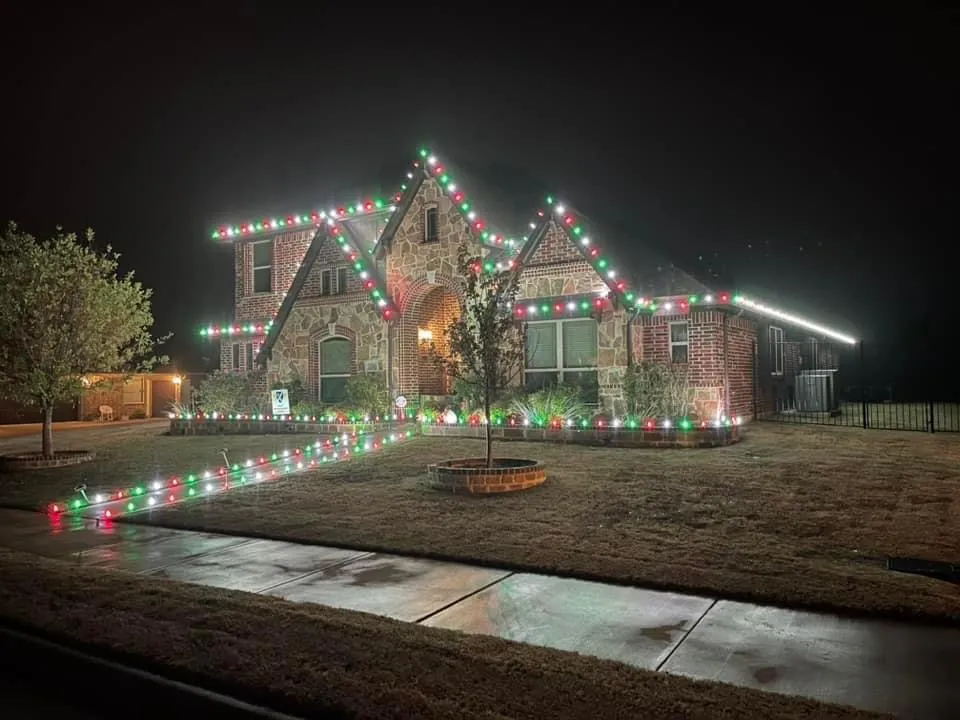
In Los Angeles, a holiday display either belongs to the house or quietly fights it. The difference is almost never budget, it is whether the lighting was chosen for the architecture standing in front of it.
Start With the Architecture, Not the Aisle
The most memorable displays in this city share one trait: they look designed for the specific home, because they were. A Mediterranean Revival estate wants warm light tracing its arches and gables; a glass-and-steel Neutra box wants restraint and a clean silhouette. Color temperature, fixture type, bulb spacing, and scale should all follow the building, not a big-box kit. That is the through-line for every neighborhood below, and the reason a thoughtful full-service decorating plan tends to outperform anything assembled from store shelves.
A quick technical note that carries across all of LA: warm white in the 2700K to 3000K range is the default that flatters stucco, stone, brick, and mature landscaping. It reads as elegant rather than novelty, and it photographs beautifully against both a clear night and the gray of a marine layer.
Beverly Hills: Mediterranean Revival and the Discipline of Warm White
The Flats, Roxbury, Bedford, Elm, are lined with Spanish Colonial and Mediterranean Revival estates: arched entries, terra-cotta rooflines, wrought iron, and broad stucco facades. The move here is disciplined, not dramatic. Trace the roofline and gables in evenly spaced warm-white C9 bulbs so the light follows the home's real geometry, then wrap the trunks and lower canopies of the ficus and king palms along the parkway. On these facades, restraint reads as money: one consistent color temperature, symmetrical placement, and clean spacing. Multicolor almost never suits a 90210 address.
Up in Trousdale, the vocabulary shifts to Mid-Century Modern, low, horizontal, glass-forward. Pull back even further: graze the flat roofline, keep fixtures concealed, and let the architecture speak. Whichever pocket you are in, precise, symmetrical Christmas light installation is what separates a designed look from a draped one.
Bel Air and Holmby Hills: Estate-Scale Displays Behind the Gates
French chateau and Mediterranean villas along Stone Canyon and Bellagio, grand European-revival estates on Carolwood and Mapleton, here the design problem is scale and sequence. A great estate display is not a facade; it is a journey that begins at the gate and carries up a long drive to the door. Line the driveway, uplight mature deodar cedars and olive trees with warm grazing light, wrap the hedges, and crown the portico with a full designer noble-fir wreath rather than a store-bought ring.
Discretion is the brief in these neighborhoods: no flashing, no inflatables, warm white throughout. This is genuinely a five-figure commission, and it is where a single accountable design team earns its keep, one group that plans the look, sources every piece, installs interior and exterior, maintains it all season, and returns in January to remove and store everything. If you would rather hand over a palette than a shopping list, our holiday decor catalog of fresh greenery, designer faux, and mercury-glass ornaments is built for exactly that.
Hollywood Hills: Facades That Read Across the Basin
The Bird Streets and Mulholland are ruled by architecture that is meant to be seen, Neutra, Lautner, and Koenig midcentury moderns and ultramodern glass boxes that glow across the entire basin. Decorative garland and bows fight these homes. Instead, the lighting should be architectural: graze the facade and clerestory lines with concealed fixtures, downlight from the eaves, and let the silhouette carry the display. Warm white keeps glass from looking clinical, while a restrained cool white can suit steel-and-glass if used sparingly and deliberately.
There is also a practical reality on these lots. The rooflines are steep, view-facing, and genuinely hard to access, and many owners want a clean look twelve months a year. That makes the Hills the strongest case in the city for permanent architectural LED, color-tunable channels tucked discreetly into the eaves that run warm for the holidays and dial down to a subtle accent the rest of the year, with no ladders on a cliffside roof every November.
Pacific Palisades and the Coast: Weather-Hardened Elegance
The Riviera's Mediterranean and Spanish Colonial Revival estates on Amalfi, the Cape Cod cottages of the Alphabet Streets, and Malibu's glass beach houses and bluff estates along PCH all share one adversary: the ocean. Salt air, the marine layer, and steady coastal wind quietly destroy ordinary product, connectors corrode, clips lift, and strands dim by mid-December. The fix is specification, not luck: marine-grade, UV-rated fixtures, sealed and gasketed connections, and fastening rated for real wind load.
Then design for the backdrop. Warm-white roofline tracing on a Cape Cod is stunning against a gray marine-layer sky, and blufftop estates are best served by lower-wattage, glare-free fixtures that lift the architecture without washing out the ocean view guests came to see. On the coast, the goal is a display that still looks like install day after eight weeks of weather.
Getting the Palette and the Plan Right
Across every one of these neighborhoods, the sequence that produces a great result is the same. Start with a single design consult, agree on a palette up front, warm white as the LA default, or a custom color story if the architecture invites one, and book early, because the best crews fill their October and November calendars by late summer. Budget honestly, too: a traditional two-story roofline typically runs into the four figures, while a gated estate with mature trees and a long drive is a five-figure commission.
Whether it is a single flawless mantel or a Bel Air estate lit gate-to-rooftop, the measure of success never changes. The display should look like it was designed for the house, because it was.
Key Takeaways
- ✓ Let the architecture lead: match color temperature, fixture type, and scale to the home's style, never a generic kit.
- ✓ Warm white (2700K to 3000K) is the LA default; multicolor rarely flatters a Mediterranean facade or a modern glass home.
- ✓ Estates read best gate-to-door, line the drive, uplight mature trees, crown the portico, and keep everything discreet.
- ✓ Modern glass homes want architectural facade grazing and eave downlighting, not garland, and are ideal for permanent LED.
- ✓ Coastal homes in the Palisades and Malibu need marine-grade, UV-rated, wind-rated, sealed fixtures to survive the season.
- ✓ Book early: the best crews fill October and November installs by late summer, with takedown in January.